Before Moià had a church
In 939 AD, Bishop Jordi of Vic consecrated Moià's parish church in the presence of Sunyer, Count of Barcelona, who had promoted its construction. The consecration document holds an extraordinary detail for this valley: it records that the chapel of Sant Jaume de la Coma already existed. That is why tradition regards it as Moià's first parish church — the place where the people of these lands gathered to pray before the town had a church of its own.
The la Coma farm is first documented in 1180, and its history has been bound to the chapel ever since — it stands barely a hundred metres from the house. Eleven hundred years later, house and chapel still stand together at the foot of the Serrat del Vent.
“This hermitage already existed when the present parish church was consecrated” — the sentence that sums up eleven centuries.
The building we see today
No visible traces remain of the early-medieval building: as with so many Catalan rural churches, the present structure is the result of 16th- and 17th-century renovation in the language of vernacular Baroque. It is a single-nave chapel without an apse, built of stone and masonry, with a gabled roof and stone-block eaves.
The western façade is its noble piece: a portal flanked by two semi-pilasters with rectangular capitals, crowned by a broken pediment with Ionic volutes and Baroque spheres. Above it, a round oculus with an iron grille lights the nave, and the ensemble is topped by an arched bell gable and a cross. Inside: a vault, a wooden altar and perimeter benches.
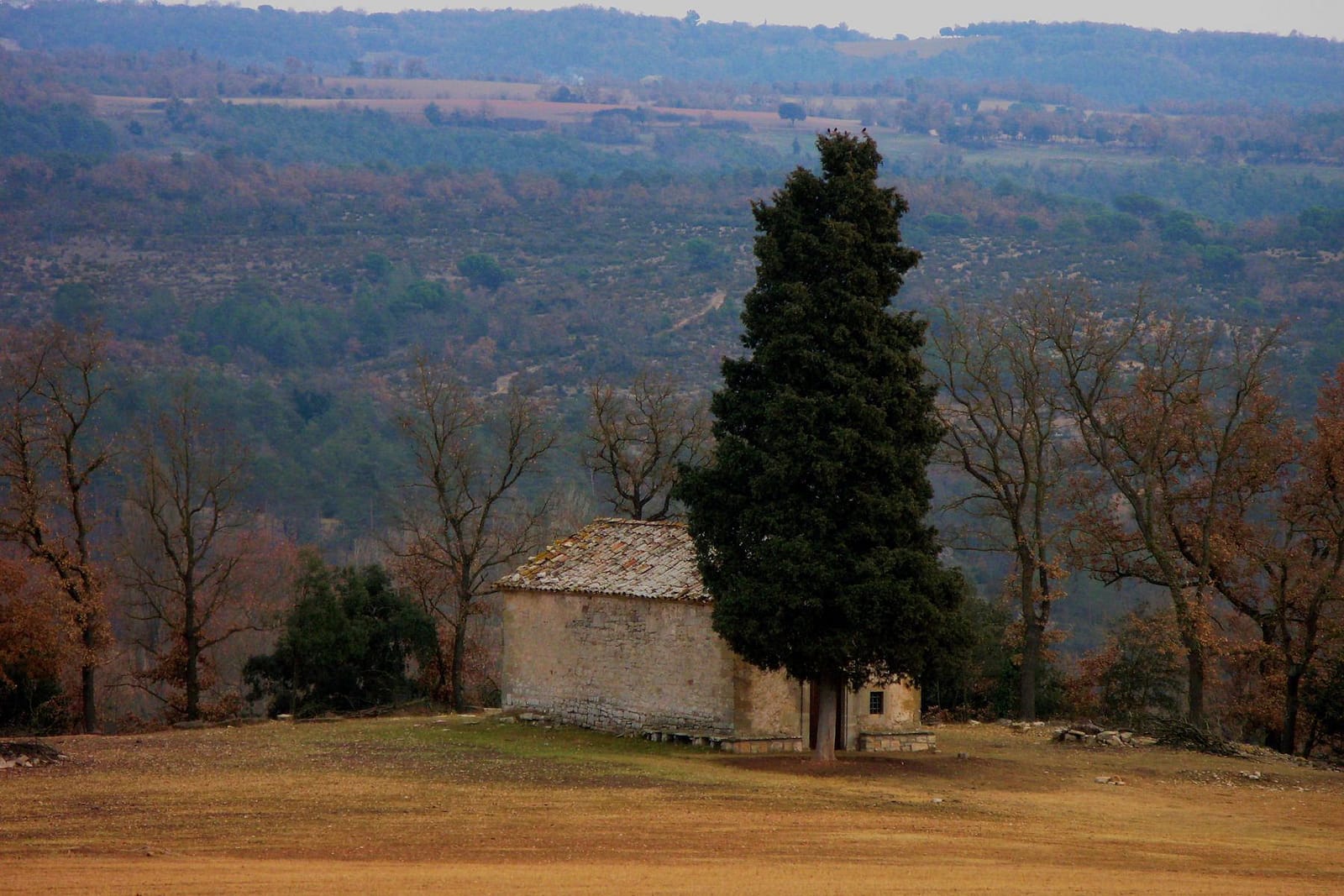
The hermitage and its cypress. Photo: “moianes” · CC BY-SA 2.0
“Francesch Coma, 1683”
In the niche above the portal — which once held the image of Saint James, now lost — an inscription is carved: “Francesch Coma, 1683”. It is the testimony in stone of the chapel's great Baroque renovation and the name of one of the men of the Coma lineage who cared for the farm and the temple for centuries. The date converses with the farmhouse lintels (1620 and 1812): three generations of history written in stone.
Saint James and the scallop shell
The chapel is dedicated to Saint James the Great (Sant Jaume), the pilgrim apostle, whose universal symbol is the scallop shell — the same shell that presides over this house's coat of arms. The Jacobean devotion, so widespread in medieval Catalonia, took root here strongly enough to name the whole estate: la Coma de Sant Jaume.
Protection and current condition
- Local Cultural Heritage Asset (BCIL) no. 821-I, declared in 1985.
- Architectural Heritage Inventory of Catalonia, IPA no. 98.
- ARCAT church census, MMO-1809.
The hermitage is in good general condition thanks to centuries of care, but an eleven-hundred-year-old building never rests: roof, stone, woodwork and surroundings demand constant attention. It is not freely accessible; visits are arranged for special occasions and research projects.
Sources
- Viquipèdia — La Coma de Sant Jaume (Architectural Heritage Inventory of Catalonia)
- Catalunya Medieval — Hermitage of Sant Jaume de la Coma
- Pobles de Catalunya — Sant Jaume de la Coma
- Cultural Heritage Maps, Barcelona Provincial Council — hermitage record